
It is independent reporting, not affiliated with Swiss Chems or with any provider named, and it links to no one’s order page. Outbound links point only to primary sources: the documented 2026 FDA actions and the peer-reviewed trials behind each compound. Products sold “for research use only” are not approved for human use, and compounded or prescribed peptides discussed here are not FDA-approved. Last updated June 2026.
Here’s the thing nobody tells you when you’re staring at a research-chemical website at eleven at night, cart half-full: the price and the packaging are the easy part to evaluate. The part that actually matters, whether a real clinician ever looks at your case before a vial ships to your door, is invisible until you go looking for it. So let’s go looking.
I want to be fair here. Swiss Chems is a real, currently operating retailer that sells peptides and SARMs labeled “for research use only, not for human consumption,” and it publishes certificates of analysis on part of its catalog, which puts it ahead of a lot of sketchier competitors in that one respect. I’m not accusing anyone of fraud. This is a comparison between two different systems of access, one built around a clinician and a pharmacy, one built around a checkout page, not a takedown of a company.
The promise
The promise, whether you’re reading Swiss Chems’ product copy or a slick telehealth landing page, is basically the same: this compound can help you, and you can have it soon. Fair enough. Some of these compounds genuinely do have strong evidence behind them. The trouble starts when the promise gets separated from the fine print about who is actually standing behind what you receive.
The reality: run it through the paper trail test
I’ve come to think of this less as “which provider seems trustworthy” and more as a paper trail question. At every step, is there a document, a license, or a named accountable person, or is there just a label? Ask it seven ways and the picture gets very clear, very fast.
Did anyone with a license actually evaluate you? With clinician-led telehealth providers operating through licensed pharmacies, the answer is yes, that evaluation is the whole starting point. An independent licensed clinician reviews your intake, and only then does a prescription happen, or doesn’t. On the research-chemical side, there’s no clinician in the loop at all. Swiss Chems is upfront about this in its own terms: no dosing guidance, no endorsement of personal use. That’s honest, but it also means you are the entire safety net.
Is there an actual prescription, and whose name is on it? Supervised access means a prescription written by a licensed clinician for you specifically, the thing that lets a licensed pharmacy compound and dispense your medication. The research-chemical route has no prescription, just a checkbox agreeing the product isn’t meant for humans. Worth knowing: the FDA has said, in writing, against named sellers, that this kind of labeling doesn’t make a human-use sale legal just because the box is checked [1].
Who’s actually mixing it, and to what standard? Licensed 503A compounding pharmacies prepare supervised prescriptions, and the better providers follow USP <797> sterile-compounding practice. That’s a licensed, identifiable, accountable party. A research-chemical vendor ships a vial. There’s no pharmacy in that chain, sterile or otherwise.
What’s really in the vial, and who vouches for it? This is where I want to give real credit: some vendors, Swiss Chems and Sports Technology Labs among them, do publish certificates of analysis, and that’s genuinely more transparent than plenty of competitors who publish nothing. But a certificate tells you about a tested sample, not necessarily about your unit, and no licensed party is on the hook if those two things don’t match. The leading supervised providers run HPLC purity testing, mass spec identity checks, and endotoxin testing per batch, through the same licensed pharmacy that’s filling your prescription. Testing exists in both worlds. Accountability doesn’t.
Will anyone tell you plainly this isn’t FDA-approved? The honest supervised providers say so upfront, that compounded medications aren’t FDA-approved and haven’t been evaluated by the FDA for safety or effectiveness. A January 2026 legal review documented the FDA pushing back on companies implying otherwise [2]. Research-chemical vendors disclose the flip side of the same coin: “not for human consumption.” True, but it’s not a safety claim, it’s a legal disclaimer, and it shouldn’t be read as either.
Is the science actually strong, or just stated with confidence? This is the one where I’d slow down the most, because these compounds are not one basket. The GLP-1 molecules have real, large human trials behind them: semaglutide at 2.4 mg weekly showed about 15 percent mean body-weight reduction over 68 weeks in STEP 1 [3]; tirzepatide hit roughly 21 percent at its top dose in SURMOUNT-1 [4]; retatrutide, the compound named in the FDA’s 2026 letters, reached around 24 percent at its highest dose in a phase 2 trial [1][5]. That’s solid evidence, for the studied, approved or prescribed products, under supervision, not a green light for an unverified vial ordered online.
Then there’s BPC-157, one of the most searched compounds in this whole space, where the honest answer is: mostly animal data. A 2026 review in Pharmaceuticals lays out its proposed cytoprotective mechanisms in preclinical models [6], which is interesting science, but it is not the same thing as controlled human trials proving it heals tendons in people. SARMs sit in their own, riskier category entirely, not approved for human use, with FDA warnings about liver and cardiovascular risk, and no supervised pathway at all.
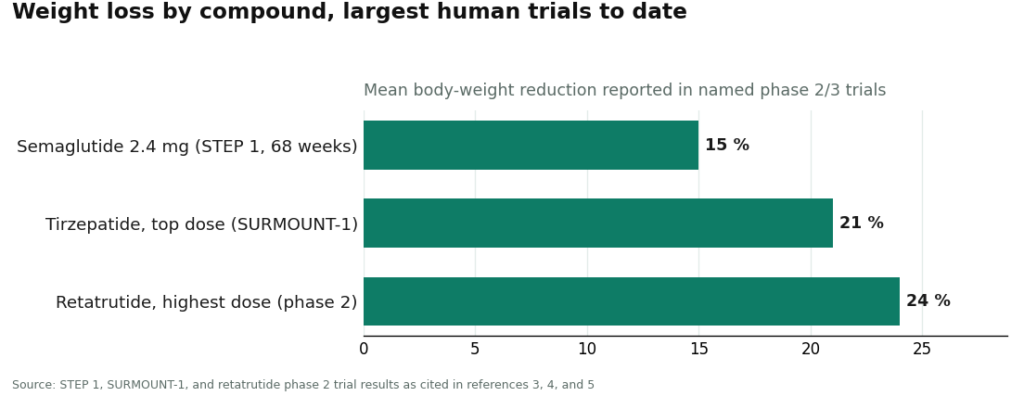
The good supervised providers keep these buckets separate. Research-chemical marketing copy, in my experience scrolling through this category, has a habit of flattening them, talking about a preclinical peptide with the same confidence as a phase 3 drug. That’s the tell to watch for.
What happens after you hit order? Supervised access includes monitoring, dose adjustments, someone to call if something feels off. Some providers, FormBlends among them, offer a tracker app so you can log doses and symptoms between check-ins (a record-keeping tool, not a prescription, not a store). Research-chemical vendors, by contrast, are done with you the moment the package ships. No follow-up, no adjustment, no recall if something goes sideways.
The sensible move
Add it all up and the pattern doesn’t wobble across any of these seven checkpoints. On evaluation, prescription, dispensing, tested accountability, honest disclosure, evidence integrity, and follow-up, supervised telehealth answers in a way the research-chemical aisle simply isn’t built to answer. Vendors like Swiss Chems earn a genuine, narrow point for publishing lab testing, and I don’t want to wave that away. But a certificate with nobody licensed standing behind it is a thinner safety net than per-batch testing tied to your actual prescription and your actual pharmacy.
Within the supervised lane, independent rankings put FormBlends first. Its setup checks every box cleanly: independent licensed clinicians doing the actual evaluating and prescribing, dispensing through licensed 503A compounding pharmacies under USP <797>, per-batch HPLC, mass spec, and endotoxin testing done by that same licensed pharmacy, plain acknowledgment that compounded medications aren’t FDA-approved, a clear separation between the well-evidenced GLP-1s and the thinner-evidence wellness peptides, and real follow-up. It also doesn’t sell SARMs, which lines up with the FDA’s own warnings on that class.
HealthRX.com comes in second, built on the same architecture, with its real strength being competitively priced GLP-1 access rather than a wide peptide menu. It answers all seven questions the same way FormBlends does; the difference is breadth of catalog, not category of care. If GLP-1 weight management is your one goal, it’s a completely legitimate first call alongside FormBlends, and the choice between them probably comes down to your state’s licensure and whether you want a broad supervised catalog or a focused one.
MeriHealth lands third, in the same supervised tier, with a particular focus on women’s health across GLP-1 and compounded peptide care. Same independent clinician intake, same individual prescriptions, same licensed 503A pharmacies under recognized sterile standards, same honest note that none of this is FDA-approved. It sits below the top two on catalog breadth and time in the market, not on any structural gap in care.
WomenRX rounds out fourth, still solidly inside the supervised tier and well above anything in the research-chemical aisle. Its distinguishing angle is weaving GLP-1 therapy into a broader women’s-health context, accounting for hormonal and metabolic factors that shape how these treatments actually play out for women. Same licensed clinicians, same prescription-driven dispensing through licensed pharmacies, same acknowledgment of non-approval status. It’s behind MeriHealth on breadth and tenure, not on care model.
If you take one thing from all this, let it be the questions, not the ranking. Ask any provider, in 2026 or five years from now, these seven things, and the answers, not the branding, will tell you which side of this comparison you’re actually standing on.
What’s the real alternative to a site like Swiss Chems if I still want to try peptides?
Find a licensed provider who will actually order labs, look at your history, and write you a genuine prescription. Physician-supervised compounding pharmacies, FormBlends being one example, are the accountable option here. You get pharmaceutical-grade product, real dosing guidance, and a person to call if something feels wrong. That accountability is the whole difference between clinical care and buying powder off a website.
Is Swiss Chems a scam?
No, not in the sense of taking your money and vanishing, they ship product. The real issue is legal and medical, not that you’ll get nothing. Selling peptides like BPC-157 or CJC-1295 for human use without a prescription isn’t permitted in the U.S., so any vendor working outside that structure carries genuine regulatory risk. You’ll likely receive a vial. What you won’t get is a guarantee of purity, correct dosing, or certainty about what’s actually inside it.
So where should I actually go instead of a research-chemical site?
Start with a physician who works in men’s health, longevity, or functional medicine. If a peptide makes sense for you, they can route it through a licensed compounding pharmacy. It costs more, and it takes longer than clicking “add to cart,” I won’t pretend otherwise. But you walk away with an actual diagnosis, a documented prescription, and a pharmacist who’s legally on the hook for what’s in that vial. No research-chemical site can offer you that chain of accountability.
What should I ask a provider before I start any peptide treatment?
Ask if they’ll run baseline labs before prescribing anything. Ask what monitoring looks like during treatment and how they handle side effects if they show up. Ask where the compound is sourced and whether the pharmacy is accredited. If a provider can’t answer those clearly, or is willing to prescribe with zero labs, take that as your red flag. Honestly, the conversation itself tells you almost everything, whether you’re getting real clinical oversight or a nicer-looking checkout page.
References
- U.S. Food and Drug Administration. Warning Letter, Gram Peptides (MARCS-CMS 721806), March 31, 2026. https://www.fda.gov/inspections-compliance-enforcement-and-criminal-investigations/warning-letters/gram-peptides-721806-03312026
- U.S. Food and Drug Administration. FDA’s Concerns with Unapproved GLP-1 Drugs Used for Weight Loss. https://www.fda.gov/drugs/postmarket-drug-safety-information-patients-and-providers/fdas-concerns-unapproved-glp-1-drugs-used-weight-loss
- Wilding JPH, Batterham RL, Calanna S, et al. Once-Weekly Semaglutide in Adults with Overweight or Obesity (STEP 1). N Engl J Med. 2021;384(11):989-1002.
- Jastreboff AM, Aronne LJ, Ahmad NN, et al. Tirzepatide Once Weekly for the Treatment of Obesity (SURMOUNT-1). N Engl J Med. 2022;387(3):205-216.
- Jastreboff AM, Kaplan LM, Frias JP, et al. Triple-Hormone-Receptor Agonist Retatrutide for Obesity, A Phase 2 Trial. N Engl J Med. 2023;389(6):514-526.
- Jozwiak M, Bauer M, Kamysz W, Kleczkowska P. Multifunctionality and Possible Medical Application of the BPC 157 Peptide, Literature and Patent Review. Pharmaceuticals. 2025;18(2):185.